“Is this farm-to-table?” “Are the ingredients locally sourced?” “Are these artisan-made accessories?” These days knowing where an item comes from — or how it’s made — is a big part of your purchase decision. And buying a home shouldn’t be any different. Partnerships with the most trusted builders in Northeast Florida, boasting more than a century of combined home-building experience, mean you get a quality home you can feel good about.
D.S. Ware Homes
The team at D.S. Ware Homes has been building homes and making customers for life for more than three decades. With repeated recognition from J.D. Power and Associates for their customer satisfaction and warranties, D.S. Ware’s commitment to a home goes far beyond when the last nail is hammered. Founder Donnie Ware sums it up best: “A home is the single most important purchase people will make in their lifetime and it has to be right, every time.” And that’s a philosophy they build every home with.
Dream Finders Homes
Within three years of opening, Dream Finders Homes was recognized as the “#1 Fastest Growing Private Company in Jacksonville” by The Jacksonville Business Journal, and with good reason. With an eye to the future of homebuilding, Dream Finders Homes is designing eye-catching and inviting homes. Their unique designs and commitment to superior quality materials have earned them more than 20 Parade of Home Awards from the Northeast Florida Builders Association.
Dostie Homes
With six decades and three generations of homebuilders, you might expect Dostie Homes to take it easy. But they’re still exceeding expectations, receiving the “2018 Northeast Florida Builder of the Year” award from the Northeast Florida Builders Association. Brothers Rick and Chris Dostie carry on the family’s legacy of quality homebuilding, leading a team of innovative professionals to deliver timeless luxury homes.
Labor Day can be a little bittersweet, as holidays go. Of course, it marks the unofficial end of summer, but you also get to kick back for a long weekend. At Wildlight, the warm days don’t end with the arrival of September, but with school starting up and work schedules coming off vacation time, Labor Day is still a great excuse to celebrate with friends and family with summertime traditions.
Throw a Neighborhood Barbecue
Break out the charcoal and gather at a local park &ndash or someone’s backyard &ndash and share good times over burgers, hot dogs, salads and more. It doesn’t take much to make a memorable party this way, the outdoor environment and simple pleasures are a perfect recipe for happy memories. Of course, if you really want to celebrate Lowcountry style, check out the next recommendation…
Do a Lowcountry Boil
If barbecue is quintessential Americana, a Lowcountry boil is the local flavor. Friends and neighbors gathering around for fresh seafood, sharing the day and filling their plates is a tradition that can’t be matched. Be advised: the delicious smell may attract folks from the block who you haven’t met before, but that’s how new friends are made! For more tips on a Lowcountry boil, you can check out this blog post.
Make a Splash
With kids going back to school, they’ll love an opportunity to dive into the water for some aquatic action! The beach is a perfect place to gather and have fun before it’s time to get back into the workday or schoolday routine. From Wildlight, the beach and all its excitement are just half an hour away on Amelia Island. Take the long weekend as a chance to get wet, soak up the sun and make memories.
Spend Time with Family
It’s easy to get caught up in our schedules &ndash whether it’s a job, a project to work on or after-school activities. Labor Day is a time to put on the brakes and focus on those closest to you. Instead of big plans, you can just make time together as a family, to enjoy some outdoor activities, cook together, or just relax. When life gets busy again, you’ll be glad you took the time to be together.
Our community is built for gathering and celebrating together, and Labor Day is a wonderful time to do just that. Take the long weekend to stop worrying about work and just enjoy the company of those closest to you, to socialize with your favorite people, and maybe make some new friends, too!
A seafood boil isn’t unique to the Florida Lowcountry or even to the south. Folks from Maine to Louisiana have been celebrating family, friends and good food for decades, and even the west coast has its own spin on the tradition. But there is something about being outside on a sunny day in Florida, enjoying a dish of fresh shrimp, sausage, corn, potatoes and onions with family and neighbors around that truly feels like it belongs right here in the Lowcountry.
The tradition of getting together, sharing food and time and memories is as true to this region as sitting on your front porch at sunset, waving to and chatting with your neighbors. If you have the opportunity to attend a Lowcountry boil or want to try to capture the experience wherever you are, here are a few tips to make the most of this grand get-together.
• Fresh is best. A good boil is all about the ingredients, especially the seafood. Down here, a boil will use shrimp caught that day (or that hour!). If you have a local seafood market, we recommend stopping by and getting a heaping portion of shrimp or your shellfish of choice there.
• Be ready to get dirty. Digging into a plate of shrimp and sausage and veggies can get messy, but that’s what makes a boil so much fun. You’re around friends and family, so don’t stress and just embrace the experience. Everything tastes even better that way.
• All are welcome. A Lowcountry boil isn’t just a recipe, it’s an event best shared with others. Whether it’s family, friends, neighbors or whoever’s around (that delicious smell might just attract some new friends), it’s best to make plenty of food and enjoy the time you spend together.
If you’re throwing your own boil, we wish you luck, good food and good company. And if it seems intimidating to host, just come on down to the Florida Lowcountry for the real thing. It’s an experience you won’t regret, and you’ll make memories to savor for years to come.
Feeding FLOCO’s Future with Aquaponics
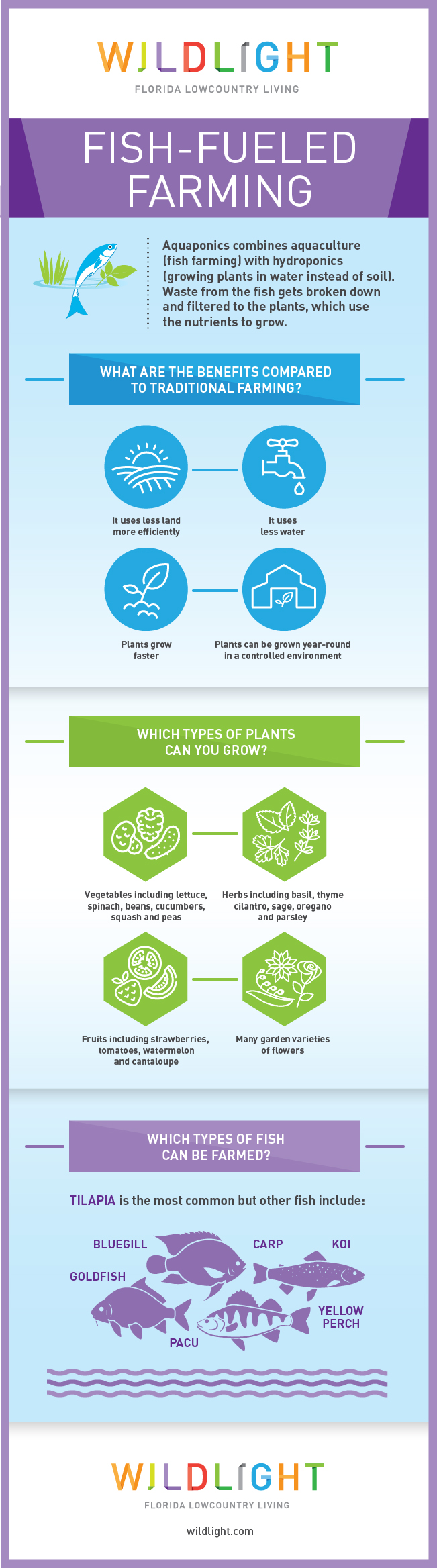
As populations grow and fewer young people enter into farming, the need for new and cost-effective solutions to maintain food supply becomes more urgent. Aquaponics is one such innovative solution that yields ample crops with more efficient use of land and water than conventional farming techniques.
A collaboration between North Florida’s largest aquaponics farm, Traders Hill Farm, and Nassau County School District is giving Wildlight students the opportunity to learn about aquaponics. This mutually beneficial partnership allows West Nassau High School students to apply what they learn by growing lettuce for the school cafeteria.
Working with aquaponics in science classes also helps prepare Nassau County students for careers in sustainable farming.
“With our biotechnology and aquaponics program at West Nassau, we have all phases of a model workforce development program,” Director of Career and Adult Education Brent Lemond told the Nassau County Economic Development Board. “There is an employer, Traders Hill Farm, assisting us to plan curriculum and ready to hire our graduates. We have a post-secondary partner in Florida State College at Jacksonville.”
We look forward to watching this program continue to grow (no pun intended)!
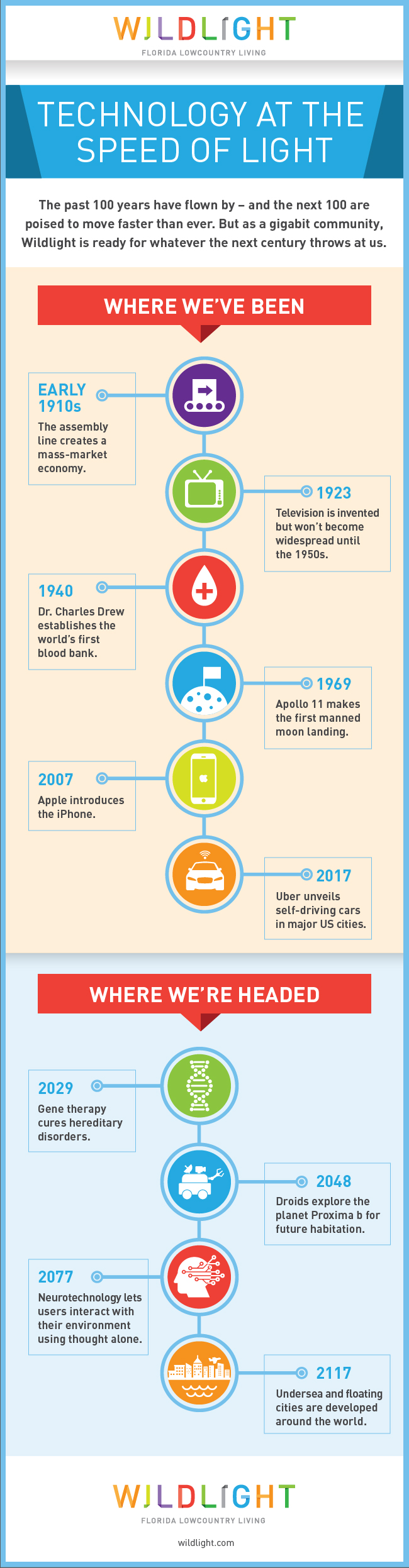
Television, personal computers, space flight… There’s no denying that the past century has been a huge one in terms of technological progress. But according to industry insiders, we’re just getting started.
In fact, some of our biggest innovators are forecasting that we’ll see more tech changes to our lifestyle over the next four to five years than we did over the past 100. What might that look like? Here are a few predictions:
1: Mind Control
Scientists have already created next-generation prosthetics where brain signals can move a robotic arm in the same way as a regular arm. The next step is wider uses for paralyzed patients, like mind-controlled wheelchairs and even day-to-day applications. The jury’s out on how soon we’ll be able to conjure up our favorite show with a thought, but experts agree it can’t be far off.
2: Bottleneck-Free Internet Access
The amount of time the average American home spends streaming, downloading and uploading, has challenged internet providers to up their game. While top providers offer average speeds of around 50 Mbps, that’s a snail’s pace compared to the gigabit communities now in development, which will have connections 20 times faster. Take a look at this video to see how one community is starting from scratch to bring unlimited bandwidth to its homes and businesses.
3: A Sharing Economy
You can share your home via Airbnb, borrow a dress on Rent the Runway and even lend out your private plane on OpenAirplane. These businesses are built on the idea that it’s more efficient to borrow something – say, a car – rather than own one that sits unused for 22 hours a day. Big players like Apple, Google and Uber are following this model and working on technology that will allow us to own less and share more.
4: Wall-to-Wall Screens
It’s hard to believe that your shiny new LCD TV may soon be considered an antique, but at the speed that display technology moves, it’s certainly a possibility. Imagine, walls, windows and mirrors covered with paper-thin OLED panels. Miniature chips in the screens will wirelessly connect to nearby devices, effectively eliminating TVs but bringing its viewing pleasure to every square inch of your house.
Setup for Economic Success
How do you kick off a thriving business community?
Economic development is both an art and a science. It’s not as simple as checking off a list of ingredients, but without some key elements, achieving success can be near-impossible. To build strong, vibrant communities, economic development boards are tasked with finding the right balance of work and play, business and pleasure. That way, communities can encourage businesses to build, expand or relocate, as well as homeowners to put down roots and support those businesses as customers and employees.
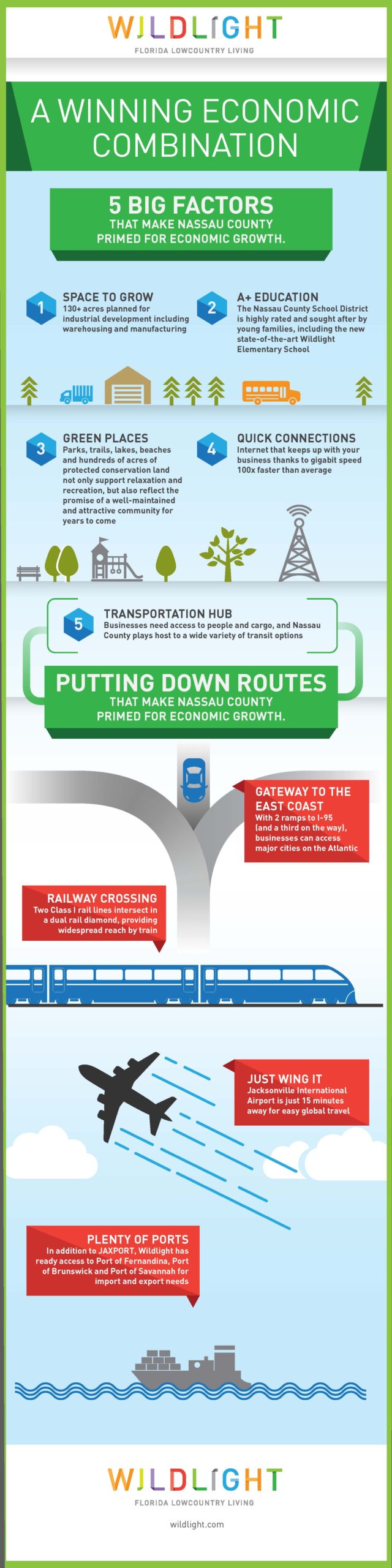
One factor communities must consider is transportation. Good transportation is not only dependent on a community’s infrastructure, but also on the location of the community itself. Access to Class I rail lines, major interstates and international airports all support business travel and consumer traffic. Seaports for importing and exporting can also impact how a business operates, manufactures its goods and distributes worldwide.
But transportation is just the beginning. For healthy economic development, you also need a quality workforce for local businesses to employ and a robust residential community to surround and support those businesses. That relies on residential perks such as smart urban design, first-rate schools and libraries and infrastructure for safety and security.
Economic development boards should make their community a place to play as well as work. Places for relaxation and recreation – lakes, oceans, greenspaces, parks, dining, entertainment and more – are essential to attracting and retaining residents. It’s not just about great offices, it’s about having a great time and loving where you live.
With these pieces in place, in a community that is well-planned for its residents and well-marketed to potential businesses, that community can grow and flourish.